The First Time I Went To Pride

For many queer people, pride is the most important event of the year. It’s a time when we get to go and be out in public not just as ourselves, but proud of it. There is no other time of year that is as positive for the queer community. These events can be found all over, and if you’re lucky you can even make it to quite a few each year.

2019 was the year that I was finally able to make it to my first pride event. I decided that I was going to take off work and go have fun even if nobody else went with me. That’s exactly what I did. I had been wanting to attend Mid South Pride for years, but had never really had the opportunity. As I approached the park, I was immediately take back by the amount of people that were there. I hadn’t really expected to see too much in a southern city like Memphis, but this event really showed me that what I had expected was not really the truth. 

I started the day by watching a few drag performances from local queens in the small stage at the front of the park. It was actually the first time I saw a drag performance live! A misconception that a lot of people have about drag is that it’s inherently some kind of bad thing, but it really depends on the performer. Seeing all of these girls working so hard to make a living off a strong hobby and with so much talent made me wish that everyone could be seeing what I was.

And that’s the crazy part: there was almost nothing at pride that was inherently “adult”. It’s a lot of people coming together to realize that we’ve all experienced oppression for our queerness. It’s a true act of rebellion to gather together and support one another. It’s a really uplifting experience to walk around a park full of tents, shops, and exhibits that all are here to celebrate queerness. It was great to be able to buy from these (mostly) super small businesses run by the community as well.

Along with just visiting the event, I also signed up to walk in the parade with Starbucks, the company I’ve worked for for the past three years. We had a float with balloons and everything! The day was super hot and the parade felt like it took forever to start, but it was an amazing experience. Here I was in the city I’d grown up in trying to find myself, and I was walking down Beale Street in a pride parade while thousands of people stood watching. A few friends from high school that I’d grown up with saw me, too. It was really nice to go from the only gay kid I knew at one point to being an activist- open and fully proud of who I am.

While pride may seem like just another party or event, it’s way more than that and always will be for me. Whenever I go to pride, I am honoring those early pioneers of equality that made this all possible. I am also paying my respects to those who have lost their lives because they are LGBTQ+ or because they chose to speak out. By attending pride, we are saying to the world: “Here we are. You can not bring us down.”

The Gay Response to the HIV/AIDS Crisis

https://www.c-span.org/video/standalone/?c4869401/user-clip-drfauci-speaks-gay-community-hiv

In this video, Dr.Fauci speaked a bit about what we can learn from the LGBTQ+ community and their response to the HIV/AIDS crisis. From what started as being believed to be a rare form of cancer that only affected gay men to becoming able to control like it is now, those people in the early days were scared because they did not have the knowledge that we do now. This is true of anything new. It takes time to gather scientific knowledge on those things that we do not fully understand. 

During the crisis, there were plenty of venues that were hotspots for the gay community that were shut down to prevent the spread of the disease. This crisis also completely change the way that individuals viewed safe sex and has propelled the practice into the importance and commonality that it has now. In time, the attitude changed from demonizing those who were gay and had the disease to raising awareness and becoming activists about the situation. 

It became quickly apparent that while it was terrible and the science was catching up, there was still a breaking community that needed to be patched and a world that continued to turn. The gay community banded together to protect each other. Instead of being viewed as terrible “filthy” people who had been cursed with a deadly illness, they turned it around to show how we can truly care for one another. Many began to beg the political leaders and scientists to put greater effort into easing the ailment of the community. Instead of fumbling around and trying to worry with the technical language that would be used to define what they were talking about, the community got to work with using what they knew that they could and fought for themselves. We educated each other practically. We did not demonize sexual behaviors, but we taught each other how to be safe and careful and to look out for our fellow queer folx who were vulnerable as well. 

We raised awareness and made the suffering known. We acknowledged the pain and used it as fuel to push forward.

The AIDS Memorial Quilt, Washington D.C. https://aidsmemorial.org/theaidsquilt-learnmore/

In our world today, it is common that people will speak up and be open about their HIV status. This is erasing the stigma and changing the way that we see those who are positive. Celebrities such as Jonathan Van Ness are leading the way toward a better outlook at the condition. We now have medications such as PreEP(https://www.cdc.gov/hiv/basics/prep.html) that can even prevent the contraction of HIV. While this is definitely not the same kind of situation as we are having with COVID-19, I definitely think that there is a lesson to be learned from the courage and education efforts of the LGBTQ+ community during the HIV/AIDS crisis that can help us to help our communities as we continue to battle widespread illness. If we stick together, even if we are not scientists or medical workers, we can get through this and be inspired by the community light of th gays during the HIV/AIDS crisis. Everything will come to pass, and we will see this crisis through.

Some information sourced from: https://www.ncbi.nlm.nih.gov/pmc/articles/PMC2625985/?page=4

Being Queer in a Quarantined World

*This post contains quotes from queer Mississippians that I know personally. For a number of reasons, I decided to keep them all anonymous. Many of them requested this themselves as well.*

“Being queer in Mississippi is an experience. I remember thinking I was the only gay person in MS until my sophomore year of high school. From the outside of Mississippi, being gay sounds like complete torture, which isn’t completely true. You’ll have your people who love and support you, but you’ll also have your close-minded people who make it very difficult. The older I got the more I felt like I wasn’t alone. Personally, I haven’t faced any harsh discrimination, but I have witnessed it all around me. Overall, I wish the state would change some of its laws and views to help the LGBT community more.”

This was a story sent to me by one of my peers. I asked a few people to tell me what their experience being queer in Mississippi was, and I got three different answers. This one seems spot-on to me, however each person’s experience is very different. 

Currently, we’re all stuck at home. That’s more than apparent. However, this fact is definitely something that is difficult for some. For a lot of young LGBTQ+ individuals, being away at university is what allows them the space to be themselves. With most if not all universities telling students to go home for the duration of the current situation, that means that many of these individuals are going to have to go back to an environment they cannot be themselves in. Some are leaving behind their significant others, and may not see them again for a long time. They may not even be able to talk about their significant other with their family, which makes it worse. Who doesn’t like talking about the people they love? 

“Most of my friends in high school were straight but most of my college friends are queer. It took me until college to come to terms with my sexuality.” 

“I’m more accepted by my Reverend than my parents.”

So to that note, I say this. To the trans siblings who are struggling with being misgendered and dead-named day after day: I see you. I accept and acknowledge you, and you are amazing. To the queer folks that have left their open environment and gone immediately home to the closet: I see you. I am you. I have been you many times before, and I know that this is something that can be overcome. This is just a season of your life, not all of it. To anyone struggling at all: Seek support. Seek help if you need it, and don’t ever forget how valuable you truly are. Your struggle is valid. If you have a loved one you know who is going through this, don’t be the person that makes them feel as if they cannot be themselves around you. Being queer is not dangerous. 

“I know that my friends will be back when this is all over, and have been keeping in good touch with them. I can’t wait to have everyone back and get our positive space back open. We will all make it through this, queer or not. But for those of us that are queer- we just gotta keep sticking together. Keep it up.”

I don’t write this to make anyone sad. I write it for awareness. Realize that romanticizing the quarantine isn’t possible for everyone involved. Be kind to one another, because nobody knows for sure what the next person has been going through while they are stuck at home. If we can all support each other and continue to share love, we can get through this. Believing that you will see the other side is the base of making it out.

Some of My Favorite Queer Books

  1. The Stonewall Reader

This book is a collection of historical documents from the eras before, during, and after the Stonewall Riots. It’s a really good insight to the real thoughts and feelings of those who were living through so much of the history that has gotten us where we are today.

  1. This Book Is Gay by Juno Dawson

Written as a guide to queer youth, this is probably the best book of its sort that I’ve ever reaad. It’s a fantastic explanation of all of the questions young people may have when they are growing up and trying to discover their identities. I cannot imagine how much I would have benefitted from having read this when I was younger.

  1. Pride: The LGBTQ+ Rights Movement

This was one of the first books I read about queer history. It begins in the early 1900s and moves through to modern day. I learned so much about history from this book, even about Harvey Milk, who is now my favorite figure of queer histroy. It takes the history that has been covered up for a very long time and brings it to light with documents, pictures, and facts that honestly surprised me. 

  1. Birthday by Meredith Russo

For those who love fiction, I highly recommend this one. It’s the most emotional LGBTQ+ fiction book I have ever read. It follows a transgender girl through her life and self-discovery. My favorite part of this was the setting: Tennessee. When we read queer fiction, it’s usually set in those places where it’s not as marginalized. The reality of being queer in the south is that our experience is very unique, and this book does a fantastic job of painting a picture of that in a raw and emotional way.

  1. Butch Heroes by Ria Brodell

I picked this one up at a bookstore in the Castro district of San Francisco. The cover wasn’t much to look at, but the content really caught my attention. Admittedly, I’m still in the middle of it, but I really love it. It starts off with a woman from 1477, which was so interesting to me. I absolutely love delving into the history of queer people before our modern time because they obviously did not have the voice or ability to be preserved as we do.

I hope that this list has inspired you to read some of the books I’ve included. Perhaps you’ll even be inspired to seek out other titles as well!

A Trip To San Francisco’s Castro District

The Castro District in San Francisco (aka “The Castro”) is probably one of the most queer-lit places in the United States. When I found out that I was going to get to visit my sister-in-law in San Jose, California, I knew that I needed to make the extra 30 minute trip over to San Francisco to finally see this place in person.

The first thing that I saw when we got out of the car was the Harvey Milk Civil Rights Academy. It’s a K-5 school dedicated to raising children in an environment and mindset of inclusion. I loved the artwork outside of the building, which showcased actual work by students behind stained glass murals.

A little bit further down the street, I found the storefront where Harvey Milk’s Castro Camera shop used to be. It’s now been converted into a Human Rights Campaign store, but standing on the street in front of the place that I knew held so much history was almost overwhelming for me. I may have bought a few too many shirts, but I don’t regret it at all.

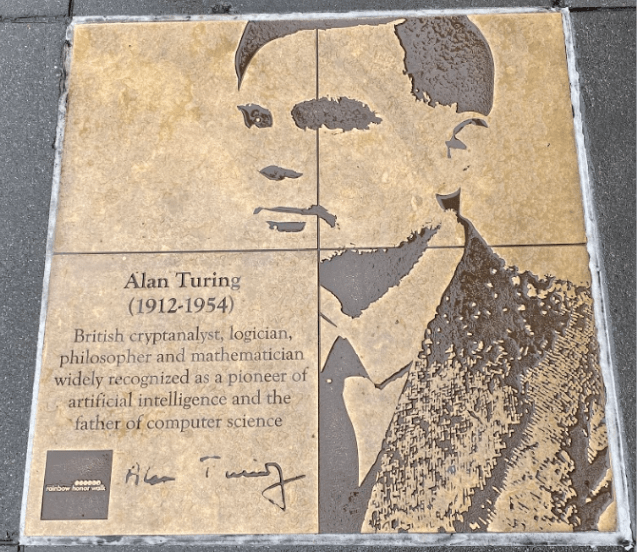
Walking around the district, there was also a “Rainbow Honor Walk” showcasing some of the most notable queer people in history. It blew my mind! I couldn’t imagine something like this ever existing in Mississippi.

Here is Alan Turing’s place on the walk:

The rest of the scenery was just amazing! I couldn’t believe there were so many rainbows in one place. Some would say that it’s too “in-your-face”, but there’s nothing better than being somewhere where you know that nobody is looking at you as the odd person out or just waiting for the perfect moment that they can jump on you. 

I also found a fantastic bookstore that had both new and used books! It was really hard to make my selections, but I managed to buy just a couple (and a LOT of postcards). 

Unfortunately, I could not go to the GLBT History Museum because it had already closed due to the COVID-19 situation. Nonetheless, I still was able to find value in my trip to The Castro and wouldn’t take back the experience for anything. I highly encourage any and all queer people to make the trip at least once in their life if they are able, because it will truly change your life. I have never felt more accepted and at home than in San Francisco’s Castro district.

Coming Out Online

LGBTQ+ youth are at a much higher risk for mental health issues as well as suicide, and supporting them helps them to know that they are never alone in their struggles. I remember being that teenager and thinking that I’d just been born completely wrong, and as I got to know more and more people who felt the same way I realized that it wasn’t as scary as I thought. I loved watching YouTube when I was growing up, and those creators are a lot of the reason I am so okay with myself as I am now. The thing about YouTubers of the old days (2009-2014ish) was that they were almost always completely normal people who just happened to make a name for themselves by making videos on the internet. 

Here’s a list of some of my absolute favorite coming out related videos that I know made me feel a little less alone in the world. I highly recommend watching through a few of these, if not all, because it is so important to listen to everyone’s stories and honor people’s experiences. The longer that we are silenced, the more we will suffer. Just as Harvey Milk once said, hope will never be silent. Hope is speaking up for each other and sharing our stories.

  1. Tyler Oakley

Tyler Oakley is probably one of the first people that come to mind when you think about gay YouTubers. He has been out for many years and has done so much to promote positivity and raise awareness for queer issues online. Here’s a video of his from 2011 that he made on how to come out and what it feels like: 

  1. Joey Graceffa

Joey Graceffa came out in a music video he posted in 2015. Rumors had spread for a while about what his sexuality was, but he used this video to finally come out to the world. At the time, it was such an amazing statement and a novel way for a creator to come out as most people would typically just sit down and film a speech-type video to talk about the topic.

He also later released a longer sit-down chat video where he explained everything and talked in more detail:

  1. Ingrid Nilsen

I watched Ingrid off and on for a few years, but I really got invested in her content when she posted her coming out video. I remember it popping up on the YouTube trending page and immediately going to watch it. Her video is very real and emotional. I also love this because we hear about gay men coming out online a lot more than we hear about lesbian women. I really connected with her story, and that’s why these stories are so important!

  1. Daniel Howell

More recently, Daniel Howell came out in a very long and emotional video in June 2019. As a popular vlogger since 2009, his sexuality had also unfortunately long been the talk of many (even though it’s really nobody’s business unless they want to tell you!). In his video, “Basically I’m Gay”, he goes through all of the issues he has experienced throughout his life related to being gay in his own unique and typical style. It’s definitely a different tone than most other coming out videos, and is pretty long for a YouTube video, but for Dan’s specific experience I think it was really appropriate. Not only does he talk about his own experience, but he gives hope to the people watching that may need to hear it!

  1. Eugene Lee Yang

Most people know Eugene from The Try Guys and how he has always been about being androgynous and breaking the binary. In his extremely artistic video “I’m Gay”, he uses dance and film to show his experience with queerness and to express who he is. If I were to try and type out a description of it, I do not believe it would do it as much justice as just watching through it would. You won’t regret seeing this one; It’s truly amazing.

For all of these creators to come out, it means a whole lot to the LGBTQ+ youth today. These kids are growing up following these creators’ content and viewing them as role models. Those who choose to come out and share their story are using the power and fame they have gained to do something positive, and I think that’s extremely strong and commendable.

A Few Ways To Be A Good Ally

So, you want to be a good ally to the LGBTQ+ community? Well, there are millions things that can help you to achieve that, but here’s a few that are super important.

  1. Share your pronouns even if you’re cis. Sharing pronouns is so important for inclusivity. A great habit that I’ve come to appreciate in myself and others is to refer to anyone who has not disclosed their pronouns to you with the singular “they”. Of course, after you know someone’s preferred pronouns, you will use those to refer to them. Never intentionally misgender someone, and apologize if you do accidentally. Everyone makes mistakes, but you should not be consciously and continually misgendering people.
  1. Go beyond just caring for those you know. The reality is that we may not know someone who covers each identity. This doesn’t mean that we cannot seek to support those identities that we are less familiar with, though. Aim to educate yourself, especially on those topics you are least knowledgeable on.
  1. Nobody likes being political, but without getting specific I just want to say this on this list: If you are voting for elected officials that are going to harm the rights of LGBTQ+ individuals, you are not an ally.
  1. Listen to individual experiences. Every person’s experience and life as an LGBTQ+ person is unique. We often have similarities, but no one person’s experience is ever going to be the same as someone else’s. 
  1. Support queer creators and their creations. There are queer writers, artists, photographers, and much more in so many places around the world. Seek them out and support them as much as you can.
  1. Don’t assume every person you meet is straight! This one is classic. You’re at your best friend’s wedding, and naturally, someone asks when you’re going to get married. For me, I get asked a lot when I’m going to “get a boyfriend”. If we eliminated this talk completely, it would eliminate that anxiety of being forced out or simply having to pretend to be straight. Approach conversations about relationships with an open mind, and don’t place heteronormative ideals on people if you don’t know if they’re straight or not. 
  1. Don’t assume everybody wants to be out or is safe to be out! If a friend comes out to you, it is never your place to tell other people about someone else’s identity, even if you think that person would not mind you telling others. Of course, if this is a mutual friend and they have been told by that person what their identity is, that’s a different story. Don’t go telling everybody you know that your friend is gay/bi/trans/ace/etc. That is their story and coming out is such a personal experience. Do not steal the power of someone else’s coming out. 

There are a million ways to be a good ally. The best way to support those immediately around you is to just ask what you can do to be more inclusive and supportive.

Harvey Milk: The Supervisor Who Gave Us Hope

Harvey Milk is by far my favorite figure of queer history. He fought for what he believed in and went where many were afraid to so that the LGBTQ+ folks of the future could have a better society to live in.

Harvey Milk became one of the first ever openly gay elected officials in the United States. He was elected as San Francisco city supervisor in 1977.

https://i1.wp.com/www.back2stonewall.com/wp-content/uploads/2018/11/Harvey-Milk-Supervisor.png?fit=596%2C335

As supervisor, Milk worked to secure the rights of LGBTQ+ people as he could. Unfortunately, Milk was assassinated by former supervisor Dan White in 1978. Milk recorded tapes before his death, obviously knowing that he would be a target.

Every time I hear that tape, I am in awe of how sincere Milk was about fighting for his cause. I am so saddened, because not many people know about him or who he was. If queer history interests you, I urge you to delve into his history much more. I definitely recommend the movie “Milk” on Netflix that chronicles his time in San Francisco.

This coming spring break, I will be travelling to San Francisco to see in person where Harvey Milk walked and made so much change. I am so excited to be able to stand in front of the old Castro Camera shop he owned and just imagine what it was like back in his day.

“It’s not about personal gain, it’s not about ego, it’s not about power. It’s about giving those young people out there, in Altoona, Pennsylvanias hope. You gotta give them hope.” -Harvey Milk

Harvey Milk
https://www.dazeddigital.com/politics/article/42369/1/harvey-milk-lgbtq-california-revolutionary-anniversary-legacy

Sources:

https://www.britannica.com/biography/Harvey-Milk

How I Found My Support System

As a queer person, I totally understand the struggles that we face. Especially in Mississippi, it can be hard to find those spaces where you feel completely comfortable being yourself. For anyone, but especially queer people, it is so important to build your support group and find people to surround yourself with that let you just be yourself! This has been quite a journey for me throughout the years, but I definitely feel that I’m currently in the best environment I’ve ever been in.

Before I moved to Oxford, I did not have as big of a support group as I have here. I had friends who accepted me, but it wasn’t quite that “queer space” that we really and truly need. For example, somebody who is trans might find it difficult to thrive in a space where they are “accepted” but people are using the wrong pronouns for them. This person then finds a group that always uses or makes a conscious and serious effort to use the correct pronouns and name for them. This is such an important difference! Acceptance is so much more than saying “I accept you!”. It’s in your language and actions every single day, but I’ll make another post about that another day as it’s a topic that can be expanded almost infinitely.

So, how did I know when I was in this extremely positive queer environment for myself? It started with moving away from home, as it does for many queer people. It is common for the beliefs of one’s family environment to not match up with their identity, and sometimes just getting out of that space is the best option when opinions are not likely to be changed so easily. (Again, another topic for another day!) Before I moved, though, I began to find that community at my workplace, which actively accepts and even celebrates the LGBTQ+ community. All of my coworkers were compassionate and I could not thank them enough for that. Not only was I accepted, but I was accepted to the point that being gay didn’t even cause a hiccup in conversation. If I was talking about my girlfriend, nobody even flinched or thought twice about it. My gayness was not some faulty personality trait in that environment;It was just me. 

Unfortunately, I had to move away from that to come to Oxford. I had just begun seeing the sprouts of the positive seeds my coworkers planted in my life, and now I had to uproot them and try to get them to grow elsewhere. This seemed such a daunting task, but I but my all into watering those seeds. I joined the student organization UM Pride, and instantly found amazing friends. That first meeting was honestly overwhelming for me because I had no idea that I would find that amount of love and support in one room. 

Since then, I’ve thrown myself into participating in nearly everything that I possibly can with Pride. I’ve attended my first pride fest, as well! It all started with taking that step and looking for the people that were going to support me. I’ve learned a lot about the LGBTQ+ community from everyone and like everyone is, I’m always still learning new things. The best way to learn about the queer experience, of course, is to interact with queer people and learn their individual experiences. I’ve gained some really amazing best friends and the community here is awesome. 

All things said, I’m so glad to have found this for myself. I don’t know how I would have survived here without such a positive queer community. There’s no doubt that some awesome things are happening at Ole Miss for the queer community. We even had the LGBTQ+ lounge in Lamar Hall open this school year! Of course, nothing is ever perfect, but every step forward is important.

So, what does my support group really look like right now? It consists of best friends, coworkers, fellow UM Pride members, events, pride fests, and a million other things that keep me grounded. If you are queer yourself, I urge you to seek out those places that celebrate and validate you and your identity. It sometimes may seem so dark around us. We may just have to work a little to go and uncover those shades that are hiding the light we are seeking, and then we ourselves can begin to glow. I wish you all of the best in looking for that support for yourselves.

At the end of the day, our community thrives on supporting each other. If we aren’t supporting each other, we’re being silent where it matters most.

Resources For LGBTQ+ Individuals

Being LGBTQ+ can be difficult sometimes, but finding the spaces that you are supported can help so much. For this post, I wanted to highlight some resources that I have personally found and loved.

  1. UM Pride Network

To start off, I just want to highlight UM Pride, our LGBTQ+ organization that we have on campus! We have meetings twice a month on average and do everything from discussing LGBTQ+ history to playing games. Whether you’re queer or not (yes! You’re absolutely welcome as an ally!), I highly recommend coming to a meeting or two! Most recently, we tie-dyed our club t-shirts together, which was super fun.

Instagram: @umpridenetwork

2. OUTMemphis

As a Memphis native, I really love to hype up this organization. They have programs for anyone of any age, and specifically a young adults group called GenQ that meets on Friday nights. I’ve attended a time or two and I definitely think that it’s a positive experience to meet other queer people and also to learn about all OUTMemphis has to offer! 

They do a lot of work for homeless youth in the community as well, which is extremely important because we often do not speak about the issue. 

For more information, visit their website: https://www.outmemphis.org/

3. The Human Rights Campaign

I don’t think anyone is a stranger to seeing the blue and yellow equal sign stickers on cars, laptops, and water bottles all around. The Human Rights Campaign, or HRC, works to help further social progress for those in the LGBTQ+ community. They have been around for quite some time, and are probably one of the most known voices for the movement today. 

Locally, they have been doing a lot of work in Mississippi. They have been working with lawmakers to make sure that queer people in the state are being protected and not discriminated against. They also will periodically hold events, most commonly around the Jackson area.

To see just what they are currently doing in our state, visit: https://www.hrc.org/local-issues/mississippi

4. GLSEN

GLSEN is an organization that helps to prevent discrimination against LGBTQ+ individuals in K12 education. They offer resources to educators so that they can create inclusive environments and make their students know that they are valued. Engaging educators in inclusivity is a crucial step to improving the lives of queer youth, and GLSEN can help to achieve that. 

Information about GLSEN is available on their website: https://www.glsen.org/

5. The Trevor Project

The Trevor Project does some extremely important work when it comes to suicide prevention. They have their own crisis hotline, TrevorLifeline,  specifically for LGBTQ+ youth. In a world where many queer youth are not getting the support that they need, this is definitely a much-needed resource. 

To see more about The Trevor Project, visit: https://www.thetrevorproject.org/

While this is just a small selection of the resources available, I hope that these can be of help to someone. As always, just a simple online search can bring up a number of different resources. Especially if you are not based in Mississippi, it can help to find more local programs and services around you. A lot of queer activism involves getting people to understand that we are here, and community involvement definitely plays an important role in achieving that. 

Design a site like this with WordPress.com
Get started